The Household Object That Changes Jobs Across Generations
See how a household object moves from daily tool to keepsake, and learn to preserve its changing meaning without forcing it into display.
The common mistake with a household object that changes jobs across generations is to call it “just a keepsake” once nobody uses it every day. That can cost the object its most revealing story: how it served a household before it became something to look at, remember, or pass along. A brass bowl, wooden stool, embroidered cloth, or chipped teapot can move through several roles without losing its connection to ordinary life.
Use gives objects their first meaning
An object often enters family memory through repetition. Someone reaches for it while cooking, folds it after a task, or sets it in the same corner because that is where it belongs. Its value may be practical rather than sentimental at first. The handle fits a familiar grip; the cloth covers a surface; the stool is light enough to carry from room to room.
Those details matter because they explain the object’s original job. A serving tray may have moved between kitchen and sitting room. A small wooden box may have held needles, letters, or household keys. The object’s shape and wear can offer clues, but they do not tell the whole story. Family members may remember the same thing differently, and one person’s account need not cancel another’s.
In homes across Eastern cultures, domestic objects can also carry associations with hospitality, craft, faith, migration, or a particular region. Those meanings are not automatically shared by everyone who owns an object of the same kind. A tea set in one household may recall daily service; in another, it may have been brought out only for a major visit. The household’s own account is more useful than a broad cultural label.
How the job changes
A change in routine can make a once-essential object less necessary. A family might begin using different cookware, move to a smaller home, or find that younger members have different habits. The old object can then become occasional-use equipment: brought out for a certain dish, a holiday, or a particular visitor. Later, even that role may fade. It may be stored, displayed, or kept because of who used it.
This shift is rarely a clean handoff from “tool” to “decoration.” An object can still be useful while becoming meaningful as a keepsake. A cloth kept in a drawer might be brought out when relatives visit. A bowl on a shelf might return to the table for a family meal. Its role can be dormant, not finished.
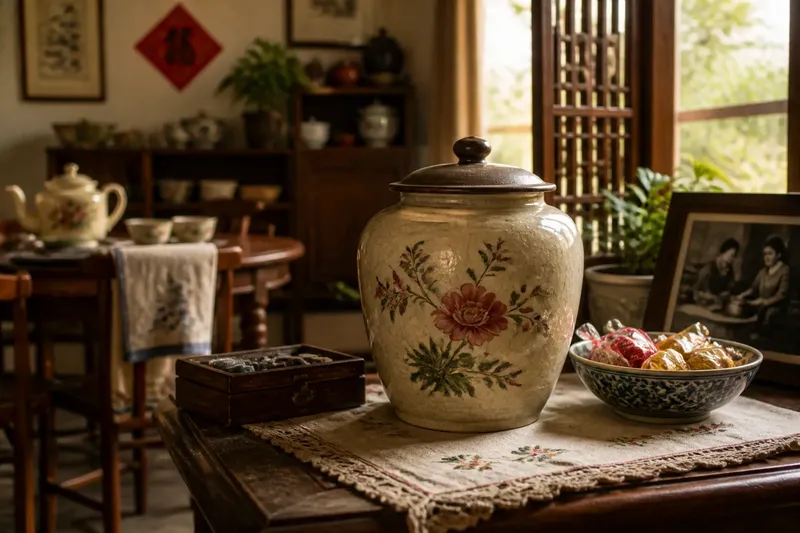
Imagine a family whose aunt used a ceramic jar to store tea leaves beside the stove. After her kitchen changes, the jar stays on a dining-room shelf. A niece later asks about the faded painted flowers, and the family starts using the jar to hold wrapped sweets when guests come. The observable change is modest: the jar is handled less often for storage but returns to use during visits, while its connection to the aunt becomes part of what people notice.
What wear can and cannot say
Scratches, discoloration, a repaired seam, or a smooth patch on a handle may help explain how an object was handled. They are evidence of contact, not a complete biography. A dent could come from daily use or from one accident. A polished surface might reflect cleaning rather than age. Ask what relatives remember before deciding what a mark means.
Material also shapes the object’s later role. Wood, metal, ceramic, paper, and textiles respond differently to light, moisture, dust, and handling. A bright windowsill may suit a sturdy ceramic piece but can fade a textile or photograph. Display is not always the gentlest way to preserve something. A clean, dry cupboard or a labeled storage box can keep an object accessible without turning it into a permanent exhibit.
Repairs deserve the same care. A visible mend may be part of the story, while a new repair might make the object easier to handle. Before altering a fragile or especially valued item, ask family members what they know and consider advice from a conservator. For ordinary care, follow the material’s care label or maker’s guidance where available.
Memory belongs to more than one person
Family objects can gather conflicting meanings. One person may remember a pot as the center of a welcoming kitchen; another may associate it with exhausting chores. Someone who inherited it may feel close to the previous owner, while a sibling may feel that the object was never theirs to begin with. These reactions can coexist. Sentiment is not a vote that produces one official story.
When an object changes hands, ask open questions: Who used it? What did it hold or do? Was it kept out or brought out for a particular occasion? What do you remember about its place in the home? Avoid supplying an answer in the question. “Was this the bowl your grandmother used for rice?” can quietly turn a guess into family fact; “What do you remember about this bowl?” leaves room for correction.
A short note can preserve what is known without pretending to settle what is uncertain. Write down the names of people who remember it, the tasks they recall, and any competing accounts. Mark guesses as guesses. If relatives agree, a photograph of the object in its former setting can add useful context, but a staged portrait should not be mistaken for a record of how it was ordinarily used.
When should an object stay useful?
Can a keepsake still be used?
Yes, if the object is sound enough for the task and the people who share it are comfortable with that use. A serving dish can remain part of a meal rather than being sealed away as a relic. If it is fragile, unsafe for food, or too important to risk, choose a gentler role instead.
How do you learn an object’s history?
Ask several people what they remember, then compare their accounts with visible details and any notes or photographs the family already has. Keep uncertainty explicit, especially when no one recalls the object’s origin. A careful “possibly” is more honest than a polished story built from assumptions.
Should inherited objects be displayed?
Display can make an object easy to see and talk about, but it is only one option. Storage near the rooms where family members gather may make it easier to bring out, handle, and explain without exposing it to constant light or dust.
What if relatives disagree about keeping it?
Separate the decision about the object from the question of whose memory is correct. Discuss whether someone wants to use it, store it, photograph it, or pass it on, and consider a temporary pause before giving away something that cannot be replaced. For valuable or contested property, seek appropriate professional advice.
Choose a role, not a verdict
When a household object changes jobs across generations, the practical question is not simply whether it is useful or decorative. Ask what role fits now: daily tool, occasional serving piece, display, shared keepsake, or carefully stored possession. A role can change again as people move, routines shift, and new memories gather around it.
Make that choice with the object’s condition and the family’s wishes in view. A shelf label can name the person associated with it; a small storage note can record what it held; leaving it within reach can preserve the option of use. The best arrangement is often the one that keeps the object’s story open, so the next generation can learn not only who owned it, but how it belonged to a home.